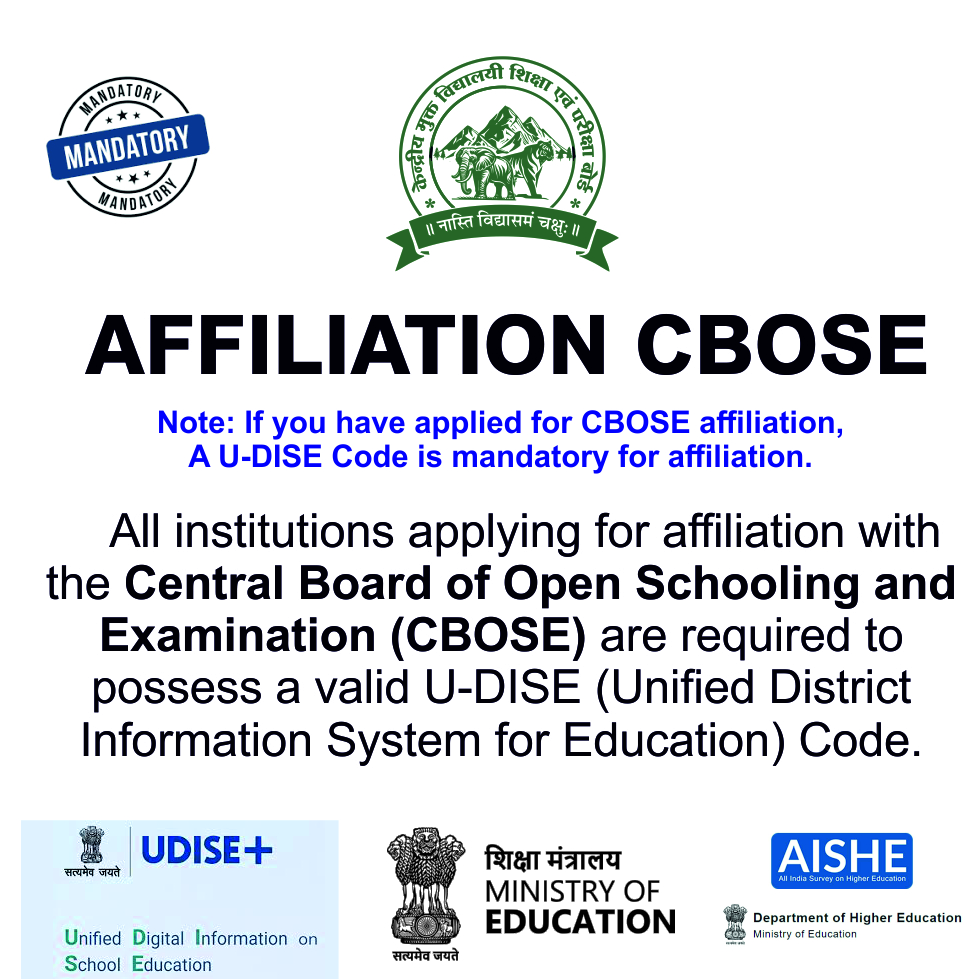
New Delhi: In a significant step towards strengthening alternative and flexible education in India, the Central Board of Open Schooling and Examination (CBOSE) has revised its affiliation guidelines with the objective of expanding the open schooling network across the country. The move aligns with the broader goals of the National Education Policy (NEP) 2020, which emphasizes inclusive, equitable, and technology-enabled learning opportunities for all.
Strengthening the Open Schooling Ecosystem
Open schooling has emerged as a crucial pillar of India’s education system, offering flexible learning pathways to students who are unable to continue with conventional schooling due to socio-economic, geographical, or personal constraints. Recognising this need, CBOSE has introduced reforms aimed at simplifying the affiliation process for schools and study centres while maintaining academic quality and transparency.
The revised guidelines focus on reducing procedural complexity, enabling institutions to participate in open schooling without facing excessive infrastructural or administrative barriers. This is expected to encourage more institutions, particularly in rural, semi-urban, and underserved regions, to join the open schooling framework.
Key Highlights of the Revised Affiliation Framework
Under the updated affiliation norms, CBOSE has placed strong emphasis on learner-centric education models. The framework promotes digital learning infrastructure, online academic support systems, transparent examination processes, and flexible admission cycles. These measures are designed to ensure that students can pursue secondary and senior secondary education at their own pace without compromising academic standards.
The new guidelines also stress accountability and quality assurance through defined academic and examination protocols. By adopting technology-driven systems for admissions, assessments, and result processing, CBOSE aims to improve efficiency, reduce delays, and enhance trust in open schooling outcomes.
Alignment with National Education Policy 2020
The reforms introduced by CBOSE reflect the core principles of NEP 2020, which calls for flexibility in learning, multiple entry and exit options, and the integration of digital tools in education delivery. NEP 2020 recognises open and distance learning as an important mechanism for achieving universal education and lifelong learning goals.
Education experts note that such reforms are essential to address the learning needs of diverse student populations, including school dropouts, working professionals, women learners, and students from remote areas. By strengthening its affiliation framework, CBOSE contributes to the policy vision of expanding educational access beyond traditional classroom settings.
Impact on Students and Institutions
The revised affiliation guidelines are expected to have a positive impact on both learners and educational institutions. For students, the reforms translate into improved access to flexible education options, better academic support, and transparent evaluation mechanisms. Open schooling provides a second chance for learners who have discontinued formal education, allowing them to complete secondary or senior secondary qualifications and pursue higher education or employment opportunities.
For institutions, the simplified affiliation process offers an opportunity to contribute to national education goals while serving diverse learner communities. Educational organisations, NGOs, and learning centres can engage with open schooling models to support inclusive education initiatives at the grassroots level.
Technology-Driven Learning and Assessment
One of the key features of the revised framework is the integration of digital technologies across academic and examination processes. CBOSE has emphasized the use of online platforms for student registration, study materials, academic communication, and assessment-related activities. Technology-enabled systems are expected to improve transparency, scalability, and efficiency, making open schooling more responsive to the needs of modern learners.
Digital assessments and data-driven monitoring mechanisms also help ensure consistency and fairness in evaluation, which is critical for building credibility and acceptance of open school qualifications.
Expanding Reach in Underserved Areas
The reforms are particularly relevant for regions where access to conventional schools remains limited. By enabling flexible affiliation and digital learning support, CBOSE aims to extend open schooling services to rural, tribal, and geographically challenging areas. This aligns with national efforts to bridge educational gaps and promote regional equity in learning opportunities.
Experts believe that open schooling can play a transformative role in addressing regional disparities in education, especially when supported by technology and inclusive policy frameworks.
Future Outlook for Open Schooling in India
With increasing emphasis on lifelong learning and skill development, open schooling is expected to gain greater prominence in India’s education landscape. The revised affiliation guidelines introduced by CBOSE signal a long-term commitment to strengthening alternative education pathways that cater to evolving learner needs.
As education systems continue to adapt to social and technological changes, open schooling boards are likely to play a crucial role in providing flexible, accessible, and learner-friendly education solutions. The reforms undertaken by CBOSE mark an important step in this direction, reinforcing the relevance of open schooling in achieving national education objectives.
Conclusion
The revision of affiliation guidelines by the Central Board of Open Schooling and Examination represents a forward-looking approach to expanding open schooling in India. By focusing on flexibility, digital integration, quality assurance, and inclusivity, CBOSE aims to strengthen the open schooling ecosystem and support the vision of universal education outlined in NEP 2020.
Education stakeholders view the move as a positive development that can enhance access, improve learning outcomes, and establish open schooling as a credible and effective alternative to traditional education systems.